
The HOA Fee That Looks Too Low

A homeowner opens the annual budget notice at the kitchen counter and sees that the monthly assessment is going up again. In hindsight, they wish they’d gone to the annual meeting.
The first reaction is predictable: “Why?” That’s a fair question. HOA boards should be able to answer it clearly. But there’s another question homeowners and boards should ask more often: What happens when assessments don’t go up enough? Keeping HOA fees artificially low can feel like good news in the moment. Over time, it can mean deferred maintenance, underfunded reserves, shrinking financial flexibility, and eventually a special assessment large enough to make everyone wish the monthly increase had happened years earlier.
HOA financial reality is not always comfortable. It is, however, manageable when boards plan ahead and homeowners understand what their assessments actually pay for.
HOA Fees Reflect Real Costs
An HOA budget is not an arbitrary number created during a board meeting. It reflects the cost of operating and maintaining the community.
Depending on the association, assessments may help pay for landscaping, insurance, utilities, management, pool service, gates, private streets, common-area maintenance, security, legal and accounting services, reserve contributions, and dozens of less visible expenses. Those costs change. Water rates rise. Labor costs change. Contractors adjust pricing. Insurance premiums can increase significantly. Aging communities need more repairs than they did when everything was new.
Boards can negotiate contracts, review expenses, and look for efficiencies. They should. But there comes a point when “holding the line” on assessments stops being financial discipline and starts becoming postponement.
Low Dues Can Hide a Bigger Problem
Buyers often see low HOA assessments as a selling point. Sometimes they are. A community with limited common areas and few amenities may simply cost less to operate. But low dues can also mean the association is not putting enough money aside for future obligations.
That is why the assessment amount by itself tells only part of the story. A financially healthy HOA should be funding current operations while also preparing for predictable future expenses. If it owns assets that will eventually need major repair or replacement, those costs do not disappear because the board wants to keep assessments low. They wait. Usually without becoming cheaper.
Reserves Are Not Extra Money
Reserve funding is one of the least glamorous parts of HOA budgeting and one of the most important.
Reserve funds are intended for major repair and replacement of common assets. Depending on the community, that could include roofs, roads, perimeter walls, pools, gates, elevators, irrigation systems, clubhouses, paint, or other infrastructure. A reserve study helps estimate when those assets will need work and what the work may cost. The purpose is simple: homeowners should contribute over time toward assets they are using today.
If a community knows a major project is coming and does not adequately prepare for it, the future board has fewer options. It may need to delay the work, borrow money, sharply increase assessments, or levy a special assessment.
None of those conversations are particularly fun.
Special Assessments Usually Have a Backstory
Special assessments are sometimes unavoidable. A major unexpected failure, natural disaster, insurance issue, or cost increase can create expenses even a well-run association could not reasonably have predicted.
But sometimes a special assessment is the final chapter of a story that began years earlier. Maintenance was postponed. Reserve contributions were kept too low. A known repair was pushed to another budget year. Then another. Eventually, the expense arrives anyway.
Responsible financial stewardship means boards should distinguish between truly unexpected costs and predictable expenses that simply have not been funded.
Homeowners deserve that distinction too.
Deferred Maintenance Gets Expensive
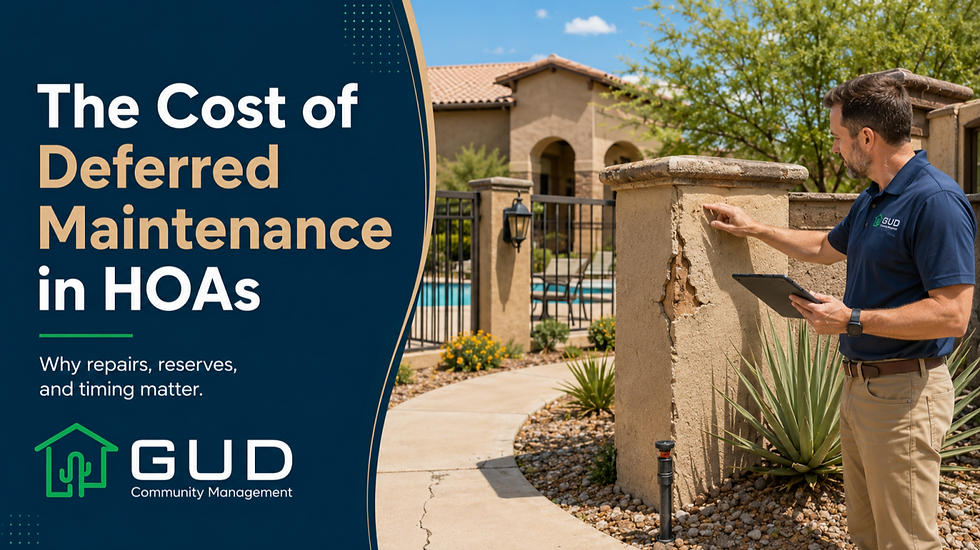
There is a financial difference between maintaining something and rescuing it. A small roof repair may prevent water intrusion. Ignoring it can lead to damaged decking, drywall, insulation, and interior finishes.
Routine pavement maintenance can extend the useful life of a private street. Waiting until the pavement fails can turn maintenance into reconstruction. The same principle applies to walls, paint, irrigation systems, pools, gates, landscaping, and other community assets. Boards sometimes postpone maintenance because they are trying to protect homeowners from higher costs. The intention may be good. The result often is not.
Good stewardship looks beyond this year’s budget and asks what today’s delay is likely to cost tomorrow.
Insurance Has Become a Bigger Budget Conversation
Insurance deserves particular attention because boards have limited control over the broader insurance market. Premiums, deductibles, coverage requirements, property values, replacement costs, and claims history can all affect what an association pays. When insurance expenses increase, boards may need to adjust the budget even though the community itself has not added a single new service. That can be frustrating for homeowners.
It is also why boards should explain significant budget changes instead of simply announcing the new assessment amount.
“Your dues are increasing” creates one conversation.
“Here is what changed in the budget and why” creates a much better one.
Financial Stewardship Requires Candor
A board’s job is not to keep assessments as low as mathematically possible.
It is to manage the association’s finances responsibly. That means reviewing expenses, funding reserves, maintaining community assets, monitoring insurance and contracts, planning for future obligations, and communicating honestly when costs change.
At GUD, we believe homeowners should be able to understand the financial decisions affecting their community. Boards should receive clear information before making those decisions, and management should help them look beyond this year’s number to the long-term financial health of the association.
Nobody celebrates an assessment increase. But an HOA with realistic dues, healthy reserves, maintained assets, and fewer financial surprises is usually in a much better position than one that can proudly say its assessments have not changed in ten years.
Sometimes the most expensive HOA fee is the one that stayed too low for too long.
—Jonathan Brown


Comments