
The HOA Repair That Got More Expensive
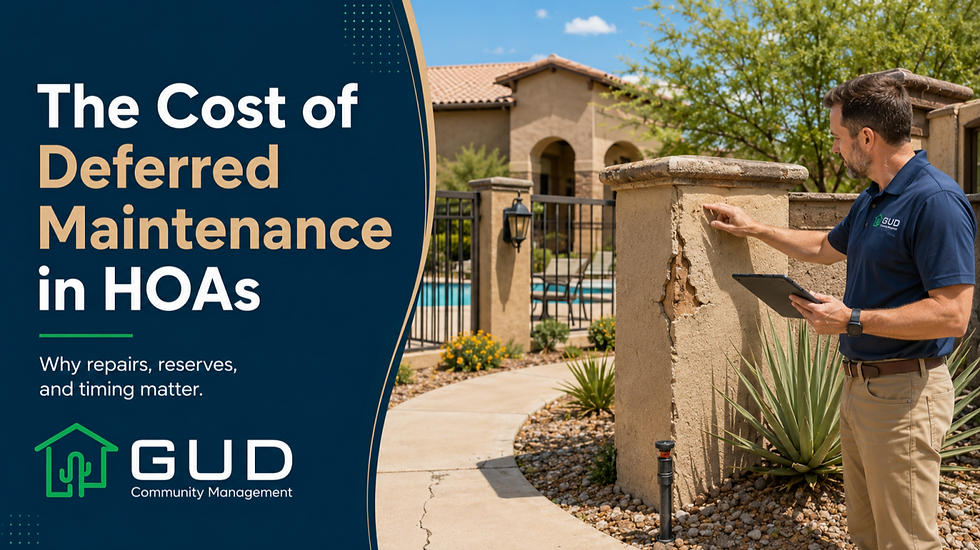
A board member walks past the same cracked section of perimeter wall for the third month in a row. It still looks manageable. There’s no immediate safety issue, and with other expenses competing for attention, maybe it can wait until next year.
Then the crack spreads. Water gets in, stucco separates, and a larger section has to be rebuilt instead of patched. The original repair did not disappear; it multiplied.
That is the financial reality of deferred maintenance.
HOA boards constantly balance competing priorities. There is never unlimited money, and not every repair can happen immediately. But delaying predictable maintenance too long often creates a larger expense later, especially in communities with aging infrastructure and shared assets.
The challenge is knowing what can wait, what should not, and how to plan for both.
Maintenance Delayed Can Become Maintenance Multiplied
Many common-area assets deteriorate gradually. Roofs begin to fail at flashing or penetrations before there is a major leak. Pavement develops small cracks before sections break apart. Irrigation systems lose efficiency before entire zones stop working. Paint begins to chalk and peel before exposed surfaces require more extensive repainting.
Early maintenance is usually less disruptive and often less expensive. Once deterioration reaches surrounding materials, structural components, landscaping, interiors, or connected systems, the scope can change quickly.
That does not mean boards should repair every cosmetic imperfection the moment it appears. It means they need a way to distinguish routine wear from conditions that are likely to become more expensive if ignored.
Reserve Funds Exist for Predictable Expenses
Reserve funds are often discussed as if they are simply money saved for “big projects,” but they are really part of a long-term plan for assets the association already knows will eventually need repair or replacement.
Depending on the community, reserve components may include:
Roofs and Exterior Building Components
Private Streets and Parking Areas
Perimeter and Retaining Walls
Pools and Recreational Facilities
Gates and Access Systems
Irrigation and Landscaping Infrastructure
Clubhouses and Common Buildings
Monuments, Lighting, and Signage
A good reserve plan helps boards avoid treating predictable replacement costs like unexpected emergencies.
If the association knows a roof system, gate, road surface, or other major asset has a limited useful life, the financial question is not whether the expense will arrive. It is whether the community will be ready when it does.
Inspections Help Boards Prioritize
Boards cannot make good maintenance decisions if no one is looking closely at the assets. Regular inspections, maintenance schedules, vendor reports, reserve studies, and management observations can help identify conditions before they become urgent.
The goal is not to create another binder that sits on a shelf. It is to give the board enough information to prioritize intelligently.
Some repairs may be mostly cosmetic. Others may affect safety, water intrusion, structural integrity, equipment life, or future repair costs. A professional evaluation can help the board understand the difference and plan accordingly.
That information also helps with budgeting. A board that knows a major gate replacement is likely within two years has more options than a board that learns the gate has failed on a Monday morning and cannot be repaired.
Prioritizing Repairs Requires Judgment
Not every association can complete every recommended project at once, so boards may need to rank maintenance based on urgency, safety, damage potential, reserve funding, contractor availability, and the impact on homeowners.
A useful approach is to separate projects into categories:
Immediate: Safety issues, active leaks, failing systems, or conditions causing ongoing damage.
Near Term: Work that is not an emergency today but is likely to become more expensive or disruptive if delayed.
Planned: Predictable repair or replacement that can be scheduled and funded over time.
That kind of structure helps boards explain why one project moves ahead while another waits. It also reduces the temptation to make maintenance decisions based entirely on which homeowner complained most recently.
Special Assessments Usually Have a History
Special assessments can happen even in well-managed communities. An unexpected failure, insurance issue, major cost increase, or unforeseen structural problem can exceed available reserves.
But sometimes the “emergency” has been visible for years. Reserve contributions were kept too low, maintenance was postponed, or a known project moved from one budget to the next. Eventually, the community reaches the point where the work can no longer wait.
That is when homeowners receive a much larger bill and understandably ask how the association got there.
Boards can make those conversations easier by communicating earlier. If a major project is approaching and existing reserves may not cover it, homeowners should hear about the issue while options still exist.
Gradual assessment increases, phased work, reserve adjustments, financing, or a planned special assessment are generally easier to discuss before a contractor is standing at the gate waiting to start.
Condos and Townhomes Face Extra Pressure
Deferred maintenance is especially important in condominium and townhome communities because the association may be responsible for substantial portions of the buildings themselves.
Roofs, exterior walls, structural components, common plumbing, stairs, walkways, drainage systems, and shared mechanical systems can involve significant costs and can affect multiple homes when they fail.
Single-family HOA communities are not immune. Private streets, walls, pools, gates, irrigation systems, landscaped common areas, entry monuments, lighting, and recreational facilities all require ongoing investment.
The assets may be different, but the financial principle is the same.
Maintenance Is Financial Stewardship
Good HOA financial management is not limited to budgets, bank balances, and financial reports. It also means protecting the physical assets those funds support.
At GUD, we believe boards should have enough information to see maintenance needs developing, understand the financial impact, and make deliberate decisions before a manageable repair becomes an emergency.
Sometimes postponing work is the right call, but “not this year” should be a decision supported by information, not a maintenance strategy repeated until something fails.
Because the repair that looks expensive today may be the bargain compared with what it costs after another year of waiting.
—Jonathan Brown


Comments